
Quick answer: four caliper measurements identify almost any plastic modular belt: pitch, rod diameter, module thickness and overall width. Add two photos, one of the top surface and one of the underside, and a supplier can name the series and quote a replacement without ever seeing the original part number.
Why the part number usually fails
Most replacement enquiries start the same way. A belt has run for three or four years, it is due for change, and the buyer goes looking for the number that was on the original order. That number is often an internal material code from the machine builder, not a belt specification. It maps to a purchasing system, not to a geometry, and a different supplier cannot decode it.
The belt itself is no more helpful by then. Moulded markings sit on the module surface, which is the part that wears. On a wet line running three shifts, the marking is usually gone.
Geometry does not have this problem. Pitch, rod diameter, thickness and width describe the physical belt. Two belts with the same four numbers and the same surface pattern are interchangeable, whatever the paperwork says. Our note on modular belt naming conventions covers how the different numbering systems relate to each other.
The four measurements
Use a vernier caliper. A tape measure is acceptable for overall width and not accurate enough for the other three.
| Measurement | How to take it | What it decides |
|---|---|---|
| Pitch (P) | Centre of one hinge rod to the centre of the next rod | The series and the sprocket. Wrong pitch means nothing engages. |
| Rod diameter (d) | Push one rod out of the module and measure the bare rod | Separates series that share the same pitch. |
| Thickness (t) | Total height of the module, top surface to bottom surface | Whether the belt clears the frame, the nose bar and the transfer plates. |
| Width (W) | Full width edge to edge, across the direction of travel | How many modules the belt is built from, and whether a standard width fits. |
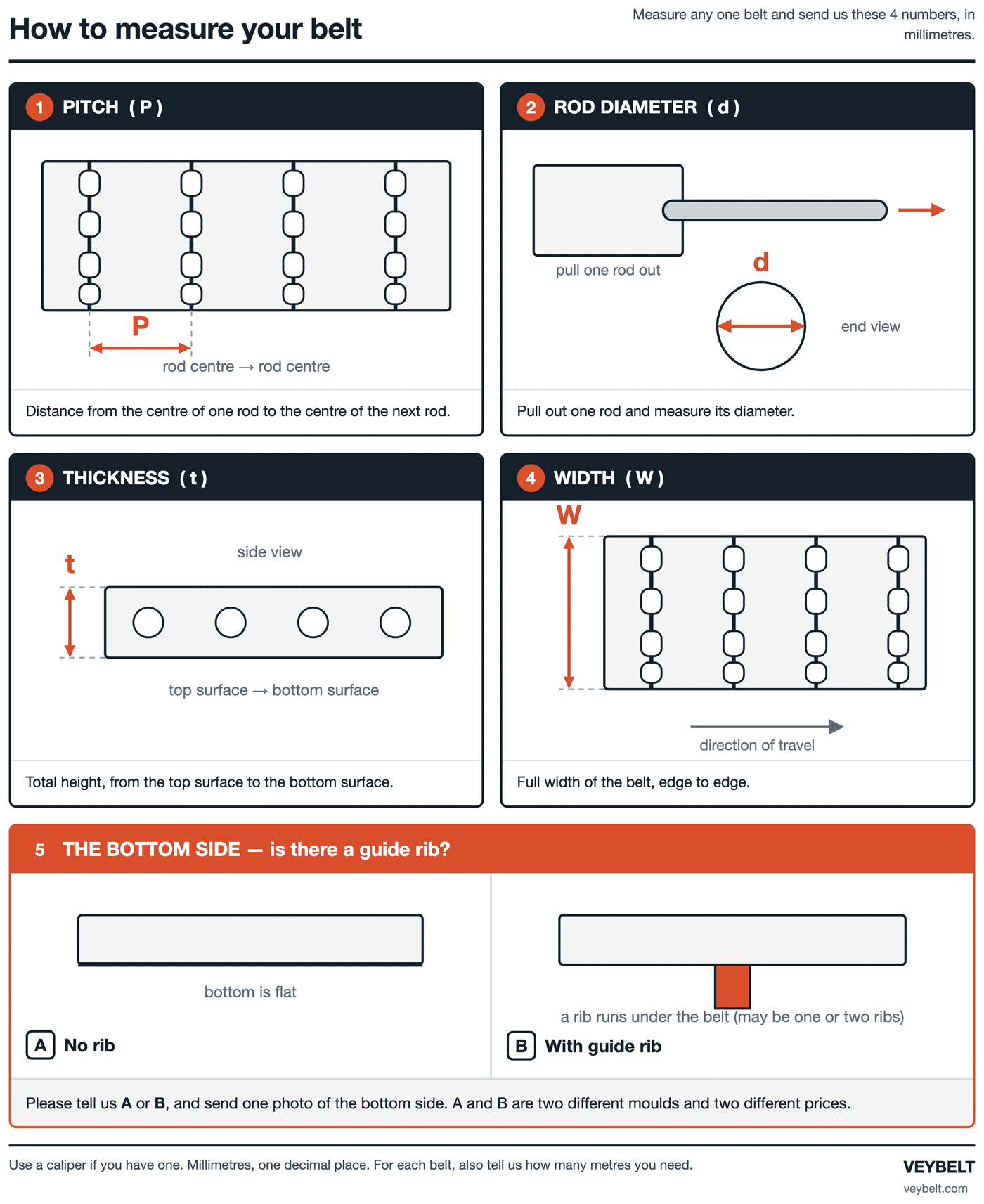
Measure pitch across ten rods, not one. On a 25.4 mm belt, a 0.3 mm reading error on a single pitch is more than one percent. Measure from the first rod centre to the eleventh, divide by ten, and that error drops by a factor of ten. This is the single measurement worth taking twice.
Take the reading off an unloaded section. A belt that has carried load for years elongates slightly and the hinge openings widen. If the plant keeps a spare module or an offcut, measure that instead of the running belt.
Nominal width and measured width are not the same number
Catalogue widths are nominal, and many of them are converted inch figures. A flat top chain plate listed at 82.6 mm is 3.25 in. Elsewhere in the same chain family you will meet an 83.8 mm plate, which is 3.30 in. The gap is 1.2 mm, and it decides which mould the parts come from.
Modular belts show the same effect at module level, where a nominal module step and the width you read with a caliper rarely agree to the millimetre. Send the number you actually measured and say that it is measured. A supplier can work back to the nominal figure. A supplier cannot guess which of two similar plates you are holding.
The two photos that decide the mould
Photograph the top surface square on, in daylight, with the belt flat. The surface type rules most candidates out straight away: fully closed flat top, open flush grid, perforated flat top, raised rib or nub top.
Then turn a module over and photograph the underside. This is the photo people forget, and it is the one that changes the tooling. Some belts carry moulded tracking lugs underneath. The lugs run inside the conveyor frame and hold the belt straight without side wear strips, and they are usually grouped on one side so the belt can still expand. A belt with lugs and a belt without them come from two separate moulds, and a flat-bottomed belt fitted to a frame built for lugs will wander off line.
If the belt runs with flights or side guards, photograph those too, with a caliper or a ruler in frame for scale.
Matching the pitch to a series
Once the pitch is known, the field narrows to a handful of candidates. These are the pitches across our range.
| Pitch | Series |
|---|---|
| 12.7 mm | 926 |
| 15.24 mm | 1100 |
| 19.05 mm | 5935 |
| 25.4 mm | 1000, 966, 976, 986, 7705, 7200; radius 2400, 7100, 916 |
| 27.2 mm | 900 |
| 38.1 mm | 936, 4802 |
| 46 mm | 300 (radius) |
| 50.8 mm | 400, 956 |
| 57.15 mm | 4809, 5997 |
Several series share 25.4 mm, which is why rod diameter and thickness matter. The 1000 series, for example, runs a slim 8.7 mm module and reaches 39,300 N/m in POM, so thickness alone often settles which of the 25.4 mm candidates you are holding. The full range is listed in the series index.
Flat top chains follow different rules. A 820 straight-running chain is a single narrow strand rather than a belt built from modules, and it is specified by plate width (82.6, 114.3 or 152.4 mm) rather than by module count.
Do the sprockets have to change as well?
This question changes how strict the match has to be, and it is worth settling early.
Keep the existing sprockets and the new belt has to engage the old tooth profile exactly. Pitch alone is not enough; the tooth form and the module underside have to agree.
Buy belt and sprockets as a set and the requirement is much easier. The set only has to fit the conveyor frame and the drive shaft. If you are replacing sprockets, add shaft diameter, bore type (round or square) and hub width to your enquiry.
What to send with the enquiry
- The four measurements in millimetres, to one decimal place
- One photo of the top surface, one of the underside
- Metres required for each belt, and the belt width
- What the belt carries and how wet, oily or hot the line runs
- Whether sprockets are included, and if so the shaft diameter and bore type
One more figure is worth adding if the line runs hot or cold: the working temperature. Plastic belts change length with temperature, and the allowance is calculated rather than guessed. The method is set out in our note on thermal expansion in plastic modular belts.
With that information a quotation is a matter of matching parts to a table. Send the measurements and photos through the contact form and we will confirm the series before anything is priced.


